Savannah cat breed
Intelligent and curious with exotic features, the Savannah cat closely resembles its wild ancestors. Find out all about this intriguing cat breed in our guide.
Pet insurance provided by Pinnacle Insurance Ltd.
Information on how we collect and use your personal data is available to read in our Privacy Policy
Savannah cat breed information and advice
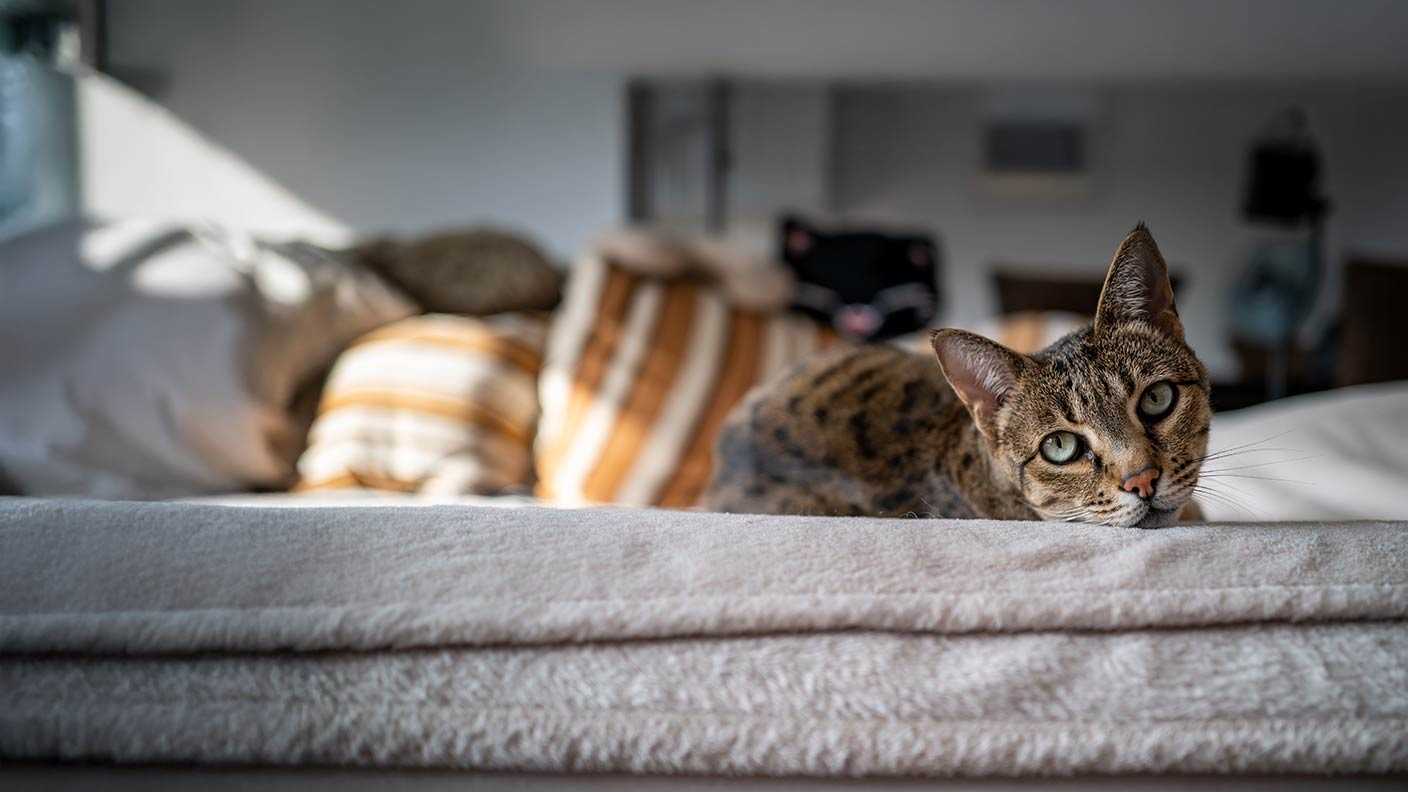
The Savannah is an exotic, hybrid breed that closely resembles its wild cat ancestor, the African Serval. This beautiful breed is tall, lean and graceful.
Each Savannah cat born is given a filial number (F) that shows how far removed they are from their wild parent - and how much wild DNA the cat has.
An F1 savannah cat indicates that the cat is first-generation, F2 is second-generation and so on. It takes at least three generations for Savannah kittens to stop being considered wildcat hybrids and purebred Savannahs - i.e. F4 Savannah kittens. Their size depends on which generation they are – F1 male Savannah cats are the largest and illegal to own without a license. In the UK, F2, F3 and F4 Savannah cats are legal and available to buy from reputable breeders.
Savannahs are active, curious cats and need a lot of interaction with their human family or other pets. They may not be suitable for everyone, especially families with small children. This breed guide will help you decide whether you should welcome a Savannah into your home.
| Savannah facts | |
|---|---|
Lifespan | 15 – 20 years |
How much | £250 – £1,800 depending on F number |
Size | 33 – 38 cm |
Weight | 5.4 – 11.3 kg |
Colours | Brown spotted, silver spotted |
Grooming | Minimal |
Temperament | Affectionate, outgoing, loyal, playful |
Exercise | Very active so need lots of exercise |
Pet insurance for Savannah cats
It’s important to protect your Savannah with pet insurance. If your cat is diagnosed with an illness, cat insurance can help cover the cost of vet bills. This includes any medication, vet prescribed complementary treatment or surgery.
Savannah cats have been bred from wild African Serval cats. This means the breed has a small gene pool they can be more prone to developing certain health conditions. These include:
• Hypertrophic cardiomyopathy (HCM)
• Hybrid male sterility
• Pyruvate kinase (PK) deficiency
If you take out kitten insurance for your Savannah cat while they’re young and before any of these conditions develop, you should be able to claim for treatment if they do develop later in life. We can’t provide cover for pre-existing health conditions.
How to care for a Savannah cat
Feeding and nutrition
This breed tends to prefer a high protein, meat-based diet. They may not be able to digest cat foods containing grains or corn. Your breeder should be able to provide details of your kitten’s diet and how often they’re fed. Savannahs are particularly susceptible to changes in their diet, and any change should be gradual to avoid tummy upsets.
Grooming
Savannah cats have a short coat and don’t need much grooming. A gentle brush once a week will do.
Their coat is black, brown spotted tabby, black silver, or black smoke in colour. It can be short to medium in length with striking dark spots and other markings. These spots can be round, oval or elongated and other distinctive features are their ears and eyes. Their ears are large and set high on top of their head. Their eyes are hooded and flat across the top. They also have a very long neck, a long body, and long legs. Their medium-length, thick tail has black rings with a black tip.
Exercise
Savannah cats love to be active and can easily get bored. If kept indoors they’ll need plenty of space for play and exercise. And they’ll need scratching posts, perches to climb and toys to keep them entertained. They also like company, so it’s best not to leave them alone all day.
Letting them outdoors will give these athletic cats room to exercise and give them the mental stimulation they need.
Savannah kittens will need to be introduced to the outside gradually to keep them safe. If you’re concerned about theft or straying while your Savannah is outdoors, read about our cover to learn more.
Training
Savannahs are an intelligent cat breed. Over time - and with plenty of positive reinforcement - they can be trained to walk on a lead. They love playing games and can be trained to ‘fetch’. Toilet training should be simple too, but make sure the litter box is large enough for their long legs.
Temperament and behaviour
As Savannahs are such a new breed, it’s hard to be specific about general character traits. Their personality will depend on how close they are to the first cross with their wildcat ancestor.
It takes at least three generations for Savannah kittens to stop being considered wildcat hybrids and purebred Savannahs.
Purebred Savannah cats are intelligent and confident. Being curious, they’ll seek out adventure and need a lot of mental stimulation. They can be destructive if they’re not entertained and are sometimes described as assertive. They need a lot of human interaction and a companion cat or ‘cat-friendly’ dog will help stop them from getting up to mischief.
Your pet Savannah will be loyal and form a strong bond with you. They’ll greet you at the door and follow you around the house. But if you’re looking for a lap cat, this won’t be the breed for you.
These cats have a high prey drive and are good hunters, due to their wildcat instincts. Other household pets such as goldfish, hamsters, gerbils, birds, etc. might not be safe in their company. If you plan on letting them outside, get your Savannah cat a collar with a bell to protect nearby wildlife from being hunted.
So, is a Savannah cat right for you?
Savannahs make lively companions. They need minimal grooming but need lots of attention in other ways. Make sure you know as much as you can about this intelligent, energetic and distinctive new breed. They may be better suited to more experienced cat owners.
Frequently asked questions
How much is a Savannah cat?
You can expect to pay between £250 – £1,800 for a Savannah kitten. The cost varies greatly depending on their generation – i.e. whether the kitten is an F1 cross or an F2, F3 or F4 etc. Breeders should be able to provide a detailed family tree for their kittens. Female Savannah cats usually cost more than males.
Are Savannah cats friendly?
The first couple of generations can be unpredictable, and there are reports of these pets being unfriendly to strangers. The more closely-related the Savannah is to the Serval, the more like its wildcat ancestor it will be.
Later generations are no more dangerous than other domestic cats. But you should never leave young children with any cat without supervision.
As they’re extremely loyal to their owners, they can be overprotective and wary of strangers. They can chirp (like their Serval ancestors) and hiss loudly – the ‘snake hiss’. Socialisation is essential to avoid hissing at strangers.
They can also meow like their domestic cat relatives and will get along with other cats.
Are Savannah cats legal in the UK?
Savannah cats are legal in the UK if they are an F2, F3 or F4 variety. It’s illegal to own an F1 Savannah cat without a Dangerous Wild Animal Licence, which an average cat owner will not be able to get.
What do Savannah cats eat?
Savannahs prefer foods their wild ancestors would have eaten. They may not have evolved to eat cat foods containing grains or corn. Ask your breeder how often they feed their Savannahs and what type of foods they give their cats and stick with this diet. It is likely to be a specialised, high protein diet that is grain and corn-free.